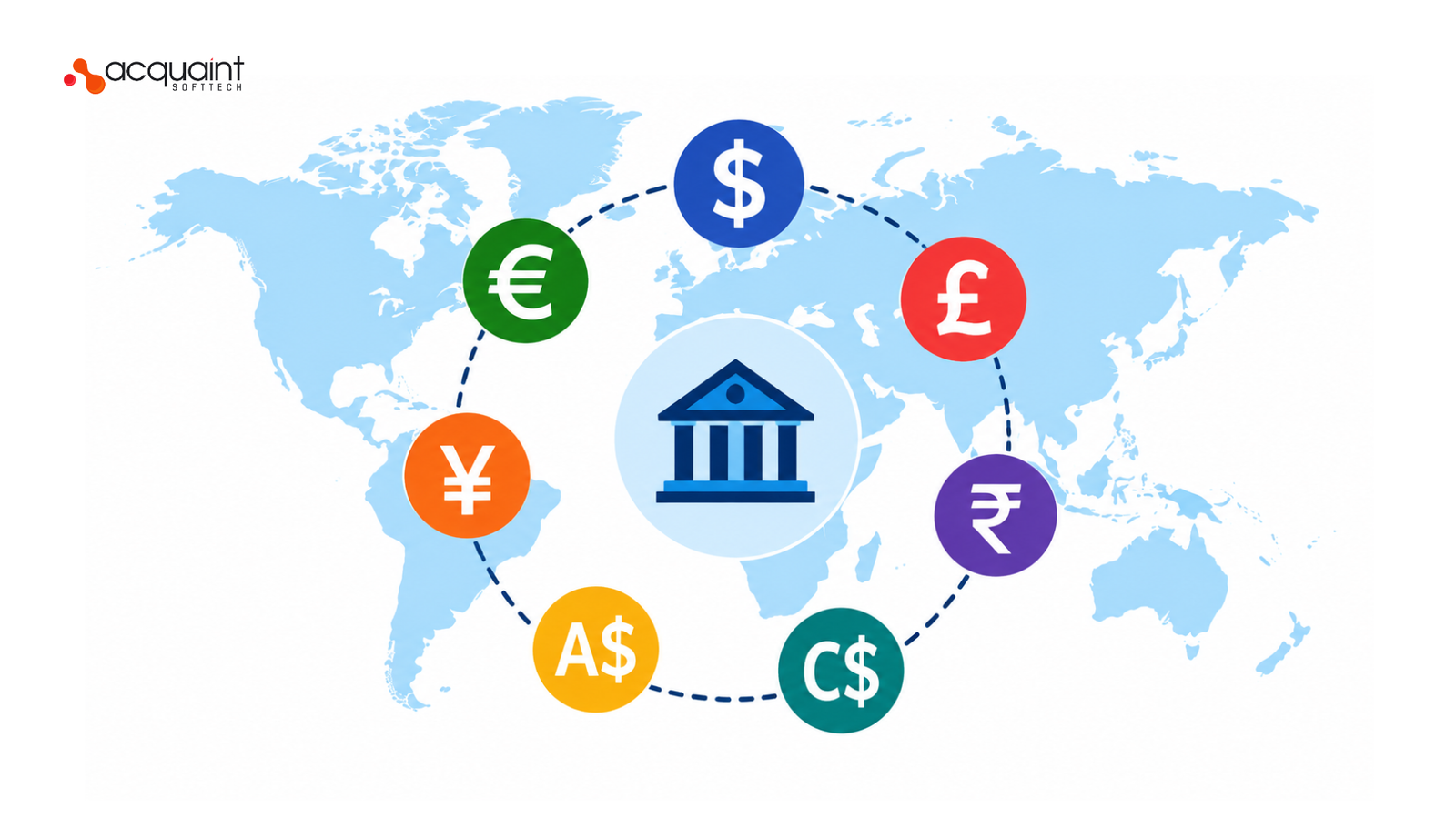
A customer in Tokyo gets charged 1,200.00 yen. The trailing zeros look harmless, but the yen has no minor units, and that one formatting slip is enough to break a payout, a refund, or a tax report. Multi-currency is full of quiet traps like this, and as the FinTech Engineering Lead at Acquaint Softtech, a software product development partner, I have watched clean-looking platforms lose money to them the moment they scale past a handful of currencies.
Handling 50+ currencies in one platform is less about conversion and more about correctness. You need to store money without precision loss, separate the currency a customer pays in from the one you settle in, source trustworthy exchange rates, and round and reconcile consistently. Get those four right and adding the fifty-first currency is trivial.
The currency rules here follow the ISO 4217 international standard. This guide draws on cross-border platforms Acquaint Softtech has built as an Official Laravel Partner, with 1,300+ projects, 70+ in-house engineers, and clients across the USA, UK, Europe, and Australia who deploy dedicated teams within 48 hours of a brief.
What multi-currency payment processing is
Multi-currency payment processing lets a customer see and pay a price in their local currency while your business receives the money in the currency you operate in. Done well, it lifts conversion, because shoppers trust a price in a currency they understand and are not surprised by a foreign charge on their statement.
It is not a single convert function bolted onto checkout. It is a data-modeling and reconciliation discipline that touches storage, pricing, settlement, and reporting, which is why teams that treat it as an afterthought pay for it later in broken payouts and audit headaches.
Presentment vs settlement currency
The core concept in multi-currency is the split between presentment and settlement currency. Presentment is the currency the customer sees and pays; settlement is the currency that lands in your bank account. The gap between them is where conversion, fees, and foreign-exchange risk live.
| Term | What it is | Example |
| Presentment currency | What the customer is charged in | A shopper pays in JPY |
| Settlement currency | What you receive in your bank | You are paid out in USD |
| FX conversion | The step that bridges the two | JPY converted to USD at a rate |
How to store money in multiple currencies
Store every amount as an integer number of minor units paired with its ISO 4217 currency code, and never as a floating-point number. Floats cannot represent many decimal fractions exactly, so using them for money guarantees rounding errors that compound across millions of transactions.
- Store minor units as integers: keep 10.50 US dollars as 1050 cents, not as 10.50.
- Always pair an amount with its currency: a number without a currency code is a bug waiting to happen.
- Respect each currency’s decimals: most currencies use 2 decimal places, the Japanese yen and Korean won use 0, and the Kuwaiti, Bahraini, and Omani dinars use 3.
- Keep the rate and timestamp: on any converted record, store the exact exchange rate used and when it was applied.
Getting the money model right is a database development problem before it is a payments problem, because a wrong schema here corrupts every report and payout downstream. This is the section most competitor guides skip, and it is the one that actually prevents financial bugs.
See also: Lightweight Aluminum Flatbed vs Steel Flatbed: Which Material Offers Better Durability?
Architecture of a multi-currency platform
A multi-currency platform is a set of services that keep currency correct at every step, from pricing to payout. The components below separate the concerns so a change to exchange-rate logic never risks the ledger.
| Component | What it does |
| Pricing and currency service | Resolves the presentment currency and price per market |
| FX rate service | Fetches, caches, and marks up exchange rates |
| Money library | Handles minor units, currency codes, and safe arithmetic |
| Multi-currency ledger | Records every amount in its original currency and a base currency |
| Gateway connectors | Charge and settle through multi-currency-capable providers |
| Reconciliation | Matches settlements and payouts back to source transactions |
The ledger and money library are the load-bearing pieces and belong in careful backend development, where a single rounding rule and idempotent processing keep the numbers provably correct under scale and retries.
Exchange rates, spread, and markup
Exchange rates come from a market data provider, and the rate you charge a customer is the wholesale rate plus a markup, called the spread. Being transparent about that markup builds trust; hiding a large spread inside a poor rate is how customers quietly learn to distrust your checkout.
- Source rates from a reliable FX provider, and cache them with a short expiry.
- Add a clear, consistent markup rather than burying it in the rate.
- Lock the rate at checkout for a short window so the customer pays what they were quoted.
- Store the exact rate used on the transaction, so every payout and refund is traceable.
Rounding and reconciliation across currencies
Pick one rounding rule and apply it everywhere, because inconsistent rounding is one of the top causes of reconciliation breaks. When you convert and split money across currencies, tiny residual amounts appear, and your system must account for every one of them so payouts sum exactly.
Round at the right stage, not repeatedly, and make sure a marketplace split adds back up to the original charge to the last minor unit. A reconciliation process that flags any mismatch immediately is what keeps finance trusting the platform, and what turns an audit into a formality instead of a fire drill.
Local payment methods and local acquiring
Showing the right currency is only half the job; customers also expect their local payment method, and processing in-region raises approval rates. Local acquiring, where the payment is processed through a bank in the customer’s region, both lifts authorization rates and lowers cost compared with sending every charge cross-border.
This is where gateway choice matters. Stripe supports 135+ currencies for global card and wallet coverage, while Adyen offers local acquiring across many markets for higher regional approval rates. Matching the gateway to your customer geography is part of the multi-currency design, not a later optimization.
Compliance and reporting across currencies
Multi-currency touches tax, invoicing, and accounting rules that differ by region, so reporting has to be currency-aware from day one. Keep the original currency on every record, report in a single base currency for accounting, and preserve the exchange rate used so figures can always be reproduced.
Regional invoicing and e-invoicing mandates, along with local tax rules, decide how amounts must be shown and stored. Building this in early is far cheaper than retrofitting it, because tax and audit requirements rarely bend to a schema that was designed for one currency.
Proof: multi-currency work for a lending platform
Acquaint Softtech built an AI document intelligence and data-extraction system for Hybopay Finance Ltd., a Dublin-based lending company, connected through secure, low-latency API infrastructure to the client’s live credit engines. This account is drawn from the client’s verified 5.0 out of 5 Clutch review.
Mid-project, the client needed to support multi-currency lending tiers. Acquaint Softtech’s engineers refactored the backend validation logic and had the staging environment updated over a single weekend, without disrupting anything else in production. The client called out that responsiveness as exactly what they wanted from an integrated team.
The engagement lived by the discipline this guide argues for. As the client put it, in automated lending even a minor decimal error does not stay minor, because it compounds through risk calculations and financial reconciliation. Precision-first money handling is not a nicety in multi-currency work; it is the whole job.
Short answers to common questions
How should I store money in multiple currencies?
A: Store each amount as an integer number of minor units with its ISO 4217 currency code, never as a floating-point number. Respect each currency’s decimals, and keep the exchange rate and timestamp on any converted record.
What is the difference between presentment and settlement currency?
A: Presentment currency is what the customer is charged in; settlement currency is what lands in your bank account. Conversion, fees, and foreign-exchange risk all live in the gap between the two.
Why not just use floating-point numbers for money?
A: Floating-point cannot represent many decimal fractions exactly, so it introduces rounding errors that compound across transactions. Use integer minor units and a money library that does safe, currency-aware arithmetic.
Do all currencies have two decimal places?
A: No. Most use two, but the Japanese yen and Korean won use zero, and the Kuwaiti, Bahraini, and Omani dinars use three. Your system must apply the correct decimals per ISO 4217.
How do I keep multi-currency payouts reconciled?
A: Apply one rounding rule everywhere, store the exchange rate on every transaction, and ensure splits sum back to the original charge to the last minor unit. Flag any mismatch immediately for finance.
What is local acquiring and why does it matter?
A: Local acquiring processes a payment through a bank in the customer’s region. It raises authorization rates and lowers cost compared with routing every charge cross-border, so it directly improves multi-currency conversion.